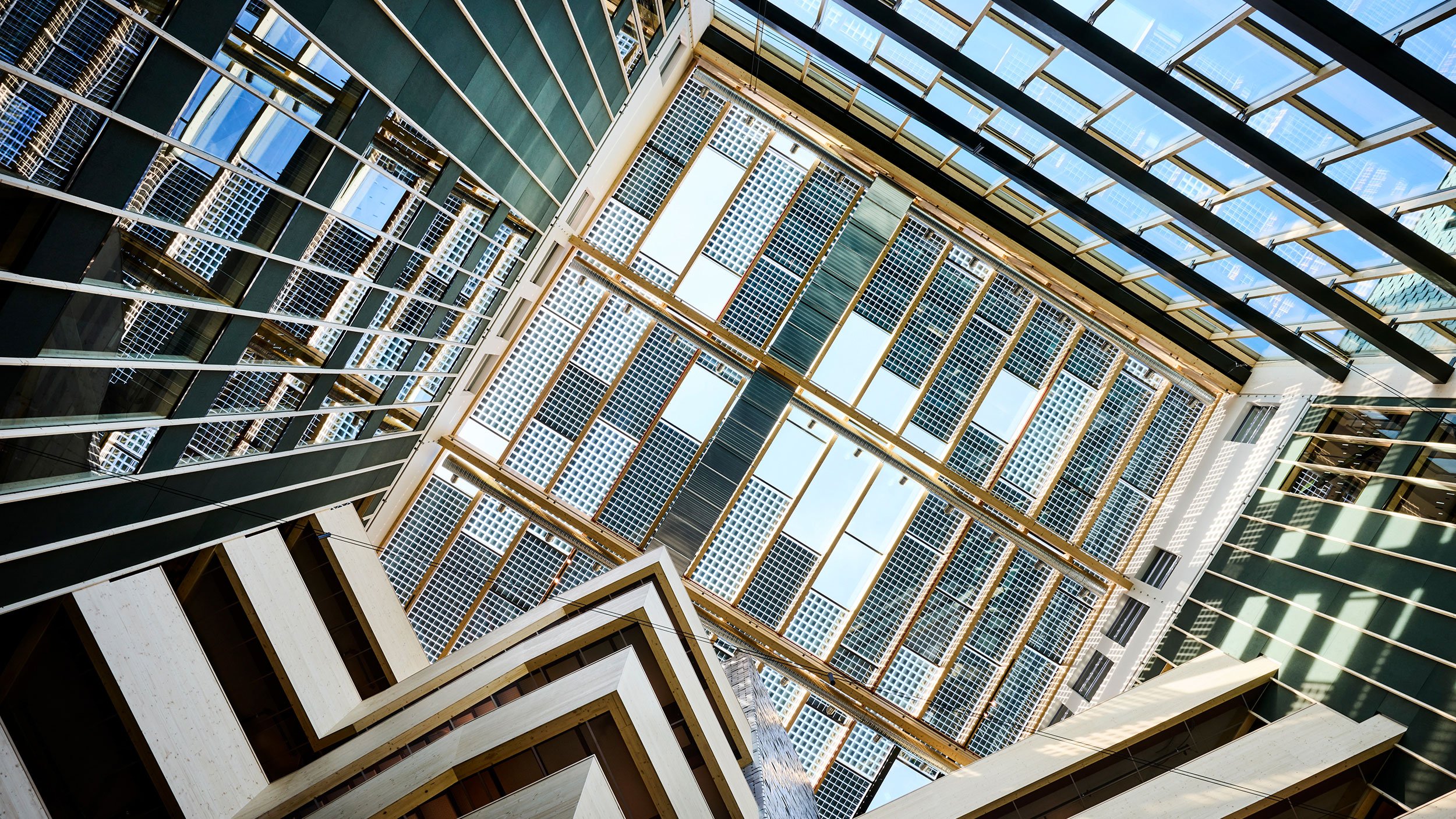
Lumi in Uppsala - Photo: White Arkitekter
Lumi has just been named Årets Bygge 2026 — the most prestigious building award in Sweden. It is the third time in eight years that this title goes to a project delivered with dRofus.
A Pattern Worth Noting
In 2019, Biomedicum at Karolinska Institutet won Årets Bygge — one of Europe's largest research laboratories, recognised for delivering a complex project ahead of schedule and significantly under budget. In 2020, Studenthuset at Linköping University claimed the same title, singled out by the jury for its innovative digital methods, exemplary collaboration, and highest possible scores across all five assessment criteria. On 17 March 2026 at Construction Summit in Stockholm, Lumi in Uppsala was named the overall winner of Årets Bygge 2026.
Three different building types. Three different project teams. Three different years. The same award. And dRofus was used on all three.
We will not overstate what that means. Award juries assess architecture, sustainability, collaboration, innovation, budget, and delivery — factors that involve hundreds of people and decisions made across years. But we think it is worth saying out loud: when the Swedish construction industry's most demanding judges look for the best building delivered that year, dRofus projects have consistently been on the shortlist and, three times now, at the top of it.
What Makes Lumi Stand Out
Lumi is an office building in central Uppsala, developed by Vasakronan and designed by White Arkitekter, with construction managed by Byggstyrnin. The project's starting point was a 1970s concrete structure that had been earmarked for demolition. Instead of tearing it down, the project team chose to rebuild from what existed — retaining the concrete frame, foundations, and staircases, and extending and upgrading the building rather than replacing it.
The results are measurable. Lumi achieved a LEED Platinum certification under LEED v4 BD+C Core and Shell, scoring 99 out of 110 possible points. That score is the highest ever recorded in Europe for any project and the highest in the world for an office building. The project halved the carbon footprint compared to an equivalent new build — 170 kg of CO₂ per square metre against the 300–400 kg typical for new construction. Energy consumption fell by 75 percent through new insulation, modern technical systems, and a solar installation covering the roof, facade, and the building's glass atrium.
The circularity index for the project stands at 40 percent. Of 6,400 tonnes of material, 1,300 tonnes were reused, 500 tonnes recycled, and 700 tonnes renewable. Materials including 110 tonnes of plasterboard, doors, glazing, radiators, and roof sheeting were reused on-site, some repurposed in new and visible ways. The building was fully let before construction was complete — a clear signal that the market values low-carbon workplaces.
A building with a lot of buzz
Lumi was also a finalist for MIPIM Awards 2026 in the category Best Conversion Project — an award sometimes described as the world cup of architecture — and was the only Swedish project nominated in any category that year. While Lumi did not take the MIPIM prize, reaching the final shortlist of four projects chosen from global submissions is a significant recognition in its own right. Lumi also won Årets LEED-byggnad/projekt 2025 from the Sweden Green Building Council, recognising its outstanding environmental performance.
The Role of Digital Process
Projects of this complexity — involving adaptive reuse at scale, high sustainability ambitions, multiple stakeholders, and demanding certification requirements — demand precise data management from the earliest stages of planning. Requirements need to be defined, tracked, and validated against evolving design decisions. Changes need to be logged and communicated across disciplines. The gap between design intent and what gets built needs to be as small as possible.
That is what dRofus is built for. Vasakronan as building owner, White Arkitekter as architect, and Byggstyrning as construction manager all used dRofus as the shared data environment for Lumi — a single source of truth connecting room data, requirements, and BIM models across the project lifecycle.
This is consistent with what the jury for Årets Bygge looks for. The award assesses five criteria: working environment, sustainability, time/quality/budget, technology and innovation, and collaboration. Each of those criteria is directly supported by structured, accessible project data. When all parties work from the same requirements database, integrated with their design models, the conditions for this kind of performance improve significantly.
A Consistent Record
Looking at the three dRofus projects that have won Årets Bygge since 2019:
| Year | Project | Building Owner | Architect | Key Recognition |
| 2019 | Biomedicum, Solna | Akademiska Hus | C.F. Møller Architects | Delivered ahead of schedule, significantly under budget |
| 2020 | Studenthuset, Linköping | Akademiska Hus | White Arkitekter | Highest scores across all five jury criteria |
| 2026 | Lumi, Uppsala | Vasakronan | White Arkitekter | Highest LEED score in Europe; finalist for MIPIM Awards |
Akademiska Hus and Vasakronan are both long-standing dRofus customers in Sweden. White Arkitekter, who designed both Studenthuset and Lumi, are a customer and one of the most active users of dRofus in the Nordic region. Byggstyrning, who managed construction on Lumi, are close partners and among the most experienced dRofus practitioners in the market.
These are organisations that have chosen to embed structured, data-driven processes into the way they work — not for a single project but as a standard approach. The results speak for themselves.
What This Means
Winning Årets Bygge once could be attributable to many factors. Winning it three times in eight years, across different clients, project types, and design teams, suggests something more structural: that the way these organisations plan, manage, and deliver buildings produces consistently exceptional outcomes.
dRofus is part of that process. We are proud to work with Vasakronan, White Arkitekter, and Byggstyrnin, and we congratulate every person who contributed to Lumi. This is the result of ambition, rigour, and genuine collaboration — and it shows what the construction industry is capable of when it takes data seriously.
Curious about the processes behind projects like Lumi, Studenthuset, and Biomedicum? We are happy to walk you through how dRofus supports teams from brief to handover.
Book an obligation-free demo
