
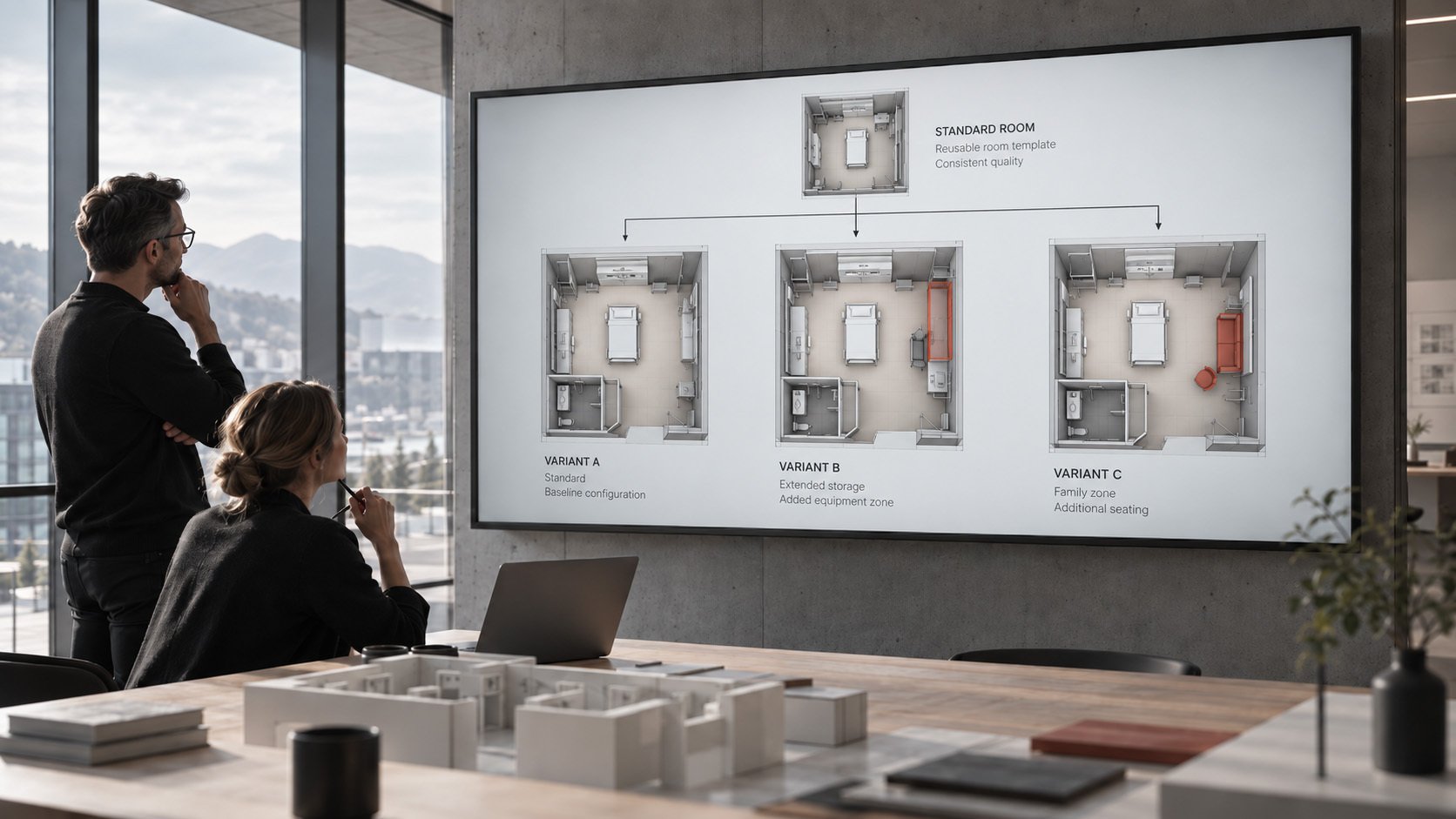
Architectural teams rarely begin every project with a completely blank page.
Previous projects contain valuable knowledge about room sizes, equipment, finishes, technical requirements and user needs. The challenge is turning that knowledge into architectural design standards that can be reused without forcing every new project into exactly the same solution.
That is where reusable room standards become valuable.
A well-structured room standard provides a reliable starting point while allowing architects and planners to adapt individual rooms when project-specific requirements demand it.
The objective is not to standardize every design decision. It is to standardize what should remain consistent and make exceptions easy to identify and manage.
What Is a Reusable Room Standard?
A reusable room standard defines the typical requirements for a recurring type of space.
For example, a consultation room, patient room, classroom or meeting room might include:
- Room function and classification
- Target or programmed area
- Furniture and equipment
- Finishes and technical requirements
- Accessibility and operational criteria
This is different from simply copying a room from an old project.
A reusable standard captures the requirements behind the room, rather than assuming that the geometry from one project should automatically become the solution for another.
The AIA's guidance on design for adaptability similarly emphasizes the importance of buildings and spaces that can accommodate change over time.
The standard provides continuity. The design remains adaptable.
1. Start With Requirements, Not Geometry
One of the most important decisions when building room standards is determining what should actually be standardized.
It can be tempting to begin with a familiar floor plan and treat that as the standard room. But geometry is often the result of requirements rather than the requirement itself.
A consultation room, for example, may need to accommodate a particular function, area, equipment set and accessibility requirement without having exactly the same shape on every project.
This creates a useful principle:
Standardize the requirement. Design the solution.
In some cases, a standardized layout will also make sense. In others, the standard should define only the information that genuinely needs to remain consistent.
2. Turn Standards Into Structured Room Data
Standards are difficult to reuse when they exist only as static documents.
Room information is often distributed across spreadsheets, PDFs, specifications, BIM models and the knowledge of experienced team members. Even when that information is correct, it can be difficult to maintain as a system.
Structured room data allows requirements such as area, equipment, finishes and technical criteria to be managed individually rather than buried inside documents.
That makes information easier to organize, compare and reuse.
Room Data Sheets are one practical way of communicating this structured information.
For a broader look at why this matters throughout the project lifecycle, see Why Structured Programming Data Matters More Than Ever for Modern Building Projects.
3. Create a Clear Room Template
Once requirements are structured, recurring room types can be turned into templates.
A good template establishes the baseline for what a room is expected to contain or achieve without creating another independent copy of the information.
In dRofus, Room Templates can include room properties such as programmed area and classification as well as Room Data and Item Lists. The same template can then be connected to multiple rooms so common requirements can be maintained centrally.
Learn how Room Templates work in dRofus.
The important question is also what not to include.
A useful test is:
Is this generally true for this room type, or is it true only because of this particular project?
Recurring requirements belong in the standard. Unusual site constraints, one-off client decisions and project-specific conditions usually do not.
A template containing every exception from every previous project eventually stops functioning as a useful standard.
4. Manage Exceptions Without Losing the Standard
No matter how carefully standards are developed, exceptions will occur.
A room may need additional equipment. Its area may change. A particular department may operate differently from the organizational norm.
That is not a failure of standardization.
The important question is whether the difference can be managed deliberately.
In dRofus, a room can receive its requirements directly from a Room Template, use Derived Room Data where selected values differ from the template, or use Unique Room Data when the room should no longer be linked to a template.
For derived rooms, template changes continue to update values that have not been overridden, while deliberate room-specific changes remain in place.
Learn more about Room Data status and derived rooms.
This creates a useful hierarchy:
Standard → Controlled deviation → Unique requirement
Rather than treating every room as either completely standard or completely unique, teams can work with different degrees of variation.
For a closer look at that relationship, see How Room Standards Support Flexible Space Planning.
5. Include Equipment and Room Content
Many spaces are defined just as much by what they contain as by their dimensions.
This is particularly important in healthcare planning, where furniture, fixtures and equipment can be closely connected to room function.
A reusable room standard can therefore include both room requirements and standardized content.
In dRofus, Room Templates can combine Room Data with Item Lists for information such as equipment, furniture and finishes.
This means a room standard can describe not only what the space needs to achieve, but also what the space is expected to contain.
6. Establish Ownership and Governance
As the standards library grows, teams need to know which information is authoritative.
A practical governance framework should define:
- Naming and classification
- Standard owners
- Approval and status
- How changes are reviewed
- When project-specific lessons should update the standard
The purpose is not additional bureaucracy.
It is to make the approved baseline easier to find and trust than an old spreadsheet or previous-project folder.
7. Connect Standards With the Developing Design
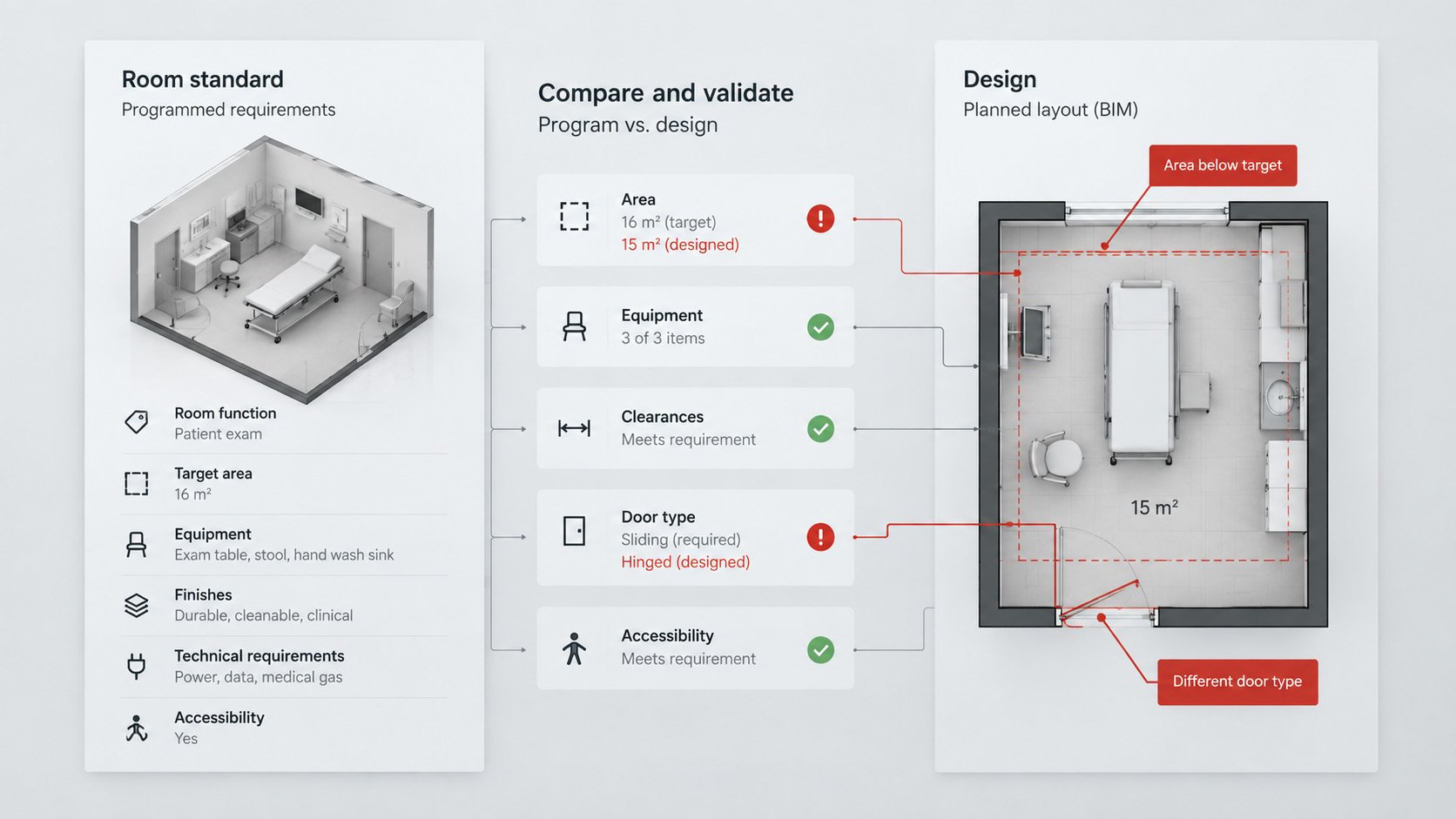
Room standards become much more useful when they remain connected to design.
Architects and planners need to be able to ask:
- Does the designed area match the programmed requirement?
- Does the room accommodate the specified equipment?
- Have deviations from the standard been identified?
- Has the design changed without the requirement changing?
This is where structured standards become more than documentation. They become a reference against which the developing design can be checked.
dRofus connects structured requirements with planning and design workflows so teams can establish room, space and equipment requirements early and compare them with the design as it develops.
Explore dRofus Space Planning or see how dRofus supports architects.
8. Reuse and Improve Standards Across Projects
The greatest value of room standards often appears over multiple projects.
Without a reusable framework, each new project may require teams to reconstruct requirements from previous documents, models and spreadsheets.
With structured standards, organizations can start from an established baseline and adapt it to the new project.
Projects also generate new knowledge. A recurring deviation, new equipment requirement or better planning solution may indicate that the standard itself should be reviewed.
A simple feedback loop is:
Standard → Project use → Exception → Review → Improved standard
This is particularly valuable for organizations that repeatedly deliver similar building types, such as healthcare systems, universities, airports and public-sector owners.
The objective is not to make every project identical.
It is to make sure that knowledge gained on one project is available to the next.
Reusable Standards Should Create Freedom, Not Restriction
The purpose of architectural design standards is not to remove project-specific thinking.
It is to prevent teams from repeatedly rebuilding information that is already known.
A strong room standards framework lets teams:
Reuse what is known.
Adapt what needs to change.
Validate the difference.
Preserve what they learn.
dRofus supports this approach by bringing room requirements, templates, equipment and project information into a structured environment connected with planning and design workflows.
The result is more than a library of standard rooms.
It is a reusable system of project knowledge.
Related Resources
- How Room Standards Support Flexible Space Planning. Explore how room standards can support consistency without limiting project-specific design decisions.
- Room Templates in dRofus. See how reusable Room Data and Item Lists are structured and applied in practice.
- Why Structured Programming Data Matters More Than Ever for Modern Building Projects. Learn how structured requirements support planning, coordination and design validation across the project lifecycle.
Frequently Asked Questions
What is a reusable room standard?
A reusable room standard defines the typical requirements for a recurring room type so they can be applied across multiple rooms or projects while still allowing project-specific changes.
What is the difference between a room standard and a room template?
A room standard defines what a room type should typically require. A room template is a practical way of structuring and applying those requirements to individual rooms.
Should room standards include a fixed layout?
Not necessarily. Standardizing requirements rather than geometry can give architects more freedom to respond to individual project conditions while preserving consistency where it matters.
How should rooms that differ from the standard be handled?
Differences should be treated as intentional deviations. Where template inheritance is available, only the values that need to differ can be overridden while the remaining requirements continue to follow the standard.
Can room standards be reused across different projects?
Yes. Reusable standards provide an established starting point for future projects, while each project can adapt them to its own users, context and constraints.